Opening Update/Disclaimer: I haven’t talked at length about Bill and Sam’s journey, which is partly because Stockholm is not the only destination in Sweden they traveled, and Bill’s input on the city from the journal entries is limited to a few sentences. Therefore, I foresee some additional pages created for this web devoted strictly to the historical record
But for now, I’ll be focusing on this present-day trip and making references from time-to-time to Bill’s journals.
Thankfully, there are plenty of records in Norway to cross-reference. This vacation won’t do it justice, but as I’ve stated in the intro, I have a little more than a week, and those two Dartmouth undergraduates had an entire summer, not to mention a being transported on a Norwegian freighter most of their trip. We’ll just have to make due with what we have.
Eventually, I’ll create an abridged version of Sam and Dave’s experience, provided Bill’s family members allow such an inclusion with their permission.
For now, I’ll document my family and I’s experience.
We left Stockholm for Oslo by train at an early hour. We were glad to leave the apartment rental, due to the lack of space and privacy. The train was sparse and services were cordial, so it was a relaxing experience. As for the view outside, the experience reminded me of traveling by train in Western Washington and Oregon, as lush forests, rivers, farmland, and small towns with modern, (not rustic) infrastructure.
Arriving in Oslo in contrast to Stockholm is like going from the past to the future. While Oslo has old buildings, the ones that survived the war, showing an average American a random picture of Oslo with language censured may trick them into thinking its Minneapolis, Seattle, or any other number of northern American metropolises that grew to prominence in only the last two centuries. One main difference however is the abundance of apartments buildings such as the district only blocks away from the central train station and the vast amount of pedestrian and bike friendly lanes, not as segregated like Stockholm from the automobile traffic, but still much less catered to automobile owners. Another point about traffic in Oslo are the right-of-way laws are a little more pedestrian-centric than in the US, as you’re expected to cross a street even if there is a red walk light as long as there’s no visible traffic. How this is catered to deaf and visually impaired people isn’t clear. There are plenty of electric vehicles that are driven in Norway, some are Teslas, (no Cybertrucks), and some electric models I haven’t heard of from China.
The other reason some Americans may be surprised by Oslo when expecting a romanticized return to antiquity are the demographics. Norway has had an immigration boom in the past two decades or so, particularly in African and Middle-East populations. There are plenty of restaurants and minimarts that service from the various Muslim-majority nations near where we are staying as well as a Mosque. This rise in demographic diversity was evident when I hiked up to the new location (changed due to the mourning of the Norwegian king) to pick up my race bib for tomorrow’s 10-kilometer race. I spotted a class of elementary schoolchildren, perhaps on a field trip, and maybe a tenth of the students were white.
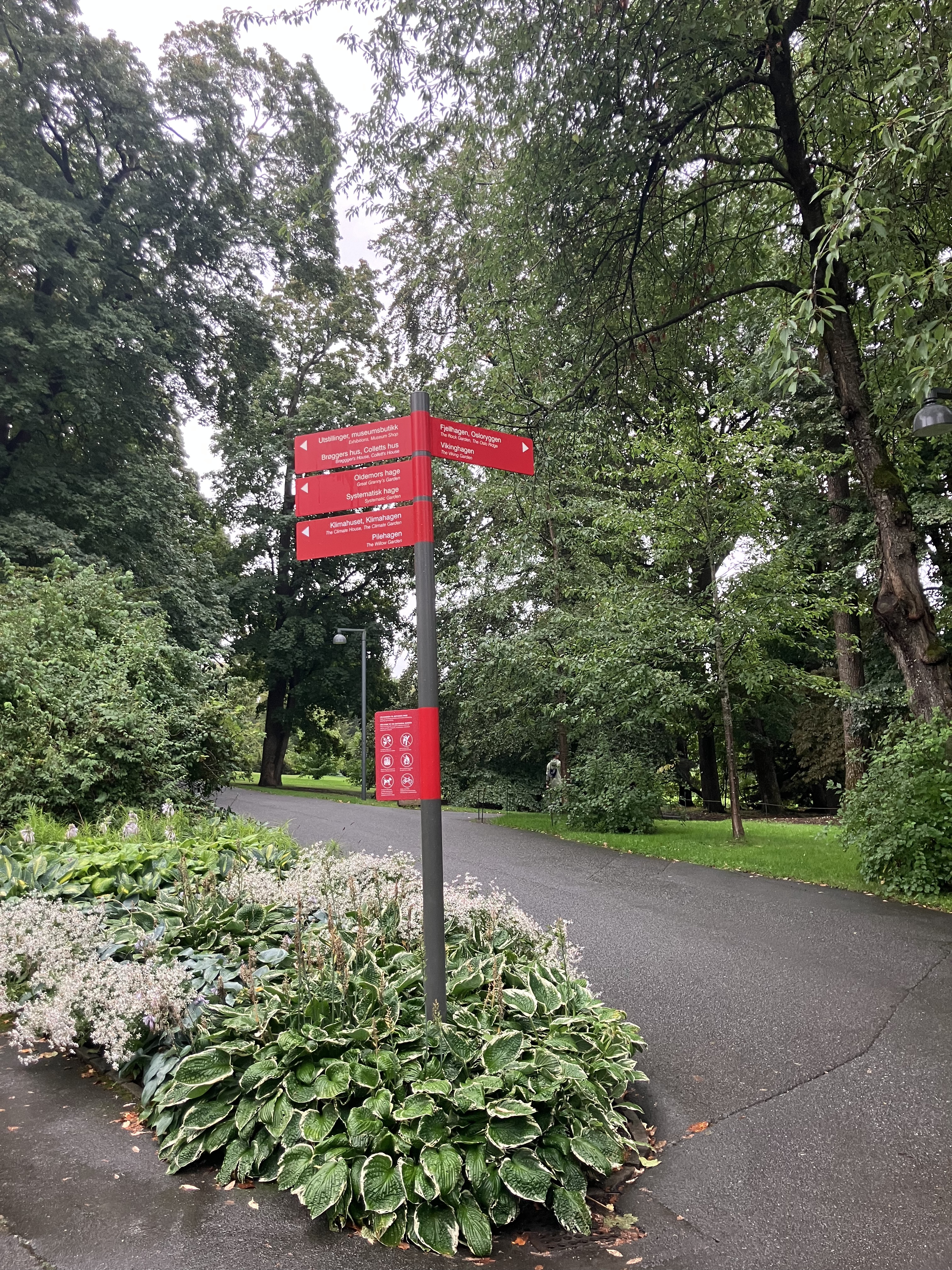
Hiking up to the bib pick-up near the Botanisk Hage (Naturhistorisk Museum), I planned on taking a tour of the museum, as it was included in the city pass I purchased for both transit and select events, but time only permitted me to explore the park campus it resided on. The entrance tent to pick up the bib greatly reminded me of a smaller, outdoor Bloomsday convention center with huge crowds of runners, mostly Norwegians I later gathered, but I managed to meet a Finn who I asked for a clarification on how to pick up my bib from volunteers, and I believe I heard a couple Germans from their speech. Thankfully, like with Sweden, the utterance of English prompts an understanding from any employee that you don’t know Norwegian and that one needs to use English as a lingua franca. Going through the rest of the tent brought the familiarities of running culture, with sponsors for shoes, socks, and other athletic equipment and apparel set up shop to cater to the thousands of runners who signed up for this event.
After picking up my bib and T-shirt in a nice tote which I can utilize to carry additional items for the flight back home, I explored the park which seemed ideal for a family weekend with museums, a soccer field, a tennis court, and other attractions tailored to communal living. One unique feature I decided to pass through was a Viking garden, similar in cultural significance as the Swedish 16th century garden next to the Vassa museum in Stockholm, but obviously more medieval. Obviously, the wild crops were probably different than were grown back in the day but the effort for the garden’s volunteers to dress in Medieval garb was a nice touch.
A side note: I personally find it interesting that Vikings are often described as a civilization or culture, as opposed to a type of job for lack of a better description. Sure, the Vikings did more than raiding and pillaging, since they traded and played politics with various places they conquered or entered royal marriages into, but it’s a little like calling Japanese civilization a Samurai civilization. But as a non-Scandinavian, perhaps there’s a flaw in my argument, and feel free to critique this analogy.
After venturing back to the apartment that we rented, my parents and I decided to forgo fine dining for a while, which should help with my budgeting in expensive Europe. My mother has also been present for several of my other races, which requires attending to a strict diet for the I the runner before the race, so she wanted to ensure that we tailored our dietary needs without having to ask a waiter to ask the cook. On the other hand, this is one of the few races I’ve competed in so late in the day, as my race group started at 16:35 or 4:35 pm. The nearest grocery store we stocked up on basics was slightly challenging as it had no English descriptions, so ensuring that I had the specific goat cheese I wanted or whether the product that I saw was in fact was shaving cream required going back and forth with my phone’s translator a number of times.
Oslo, unlike Stockholm, has less translation of its signs, directions, etc. in English. This to me is a welcome challenge, as I almost feel slightly patronized and guilty with the serendipity of my American citizenry requiring only one language, but on the other hand, travelling with my parents also made Sweden a relief for day-to-day problem solving/day-planning in contrast to Norway.
The following day, my parents and I started getting into an old habit of preparing for a race as if it was in the morning, but we did manage to make time for the Munch museum and other attractions with came across our path as we moved slowly towards the Start/Finish line.
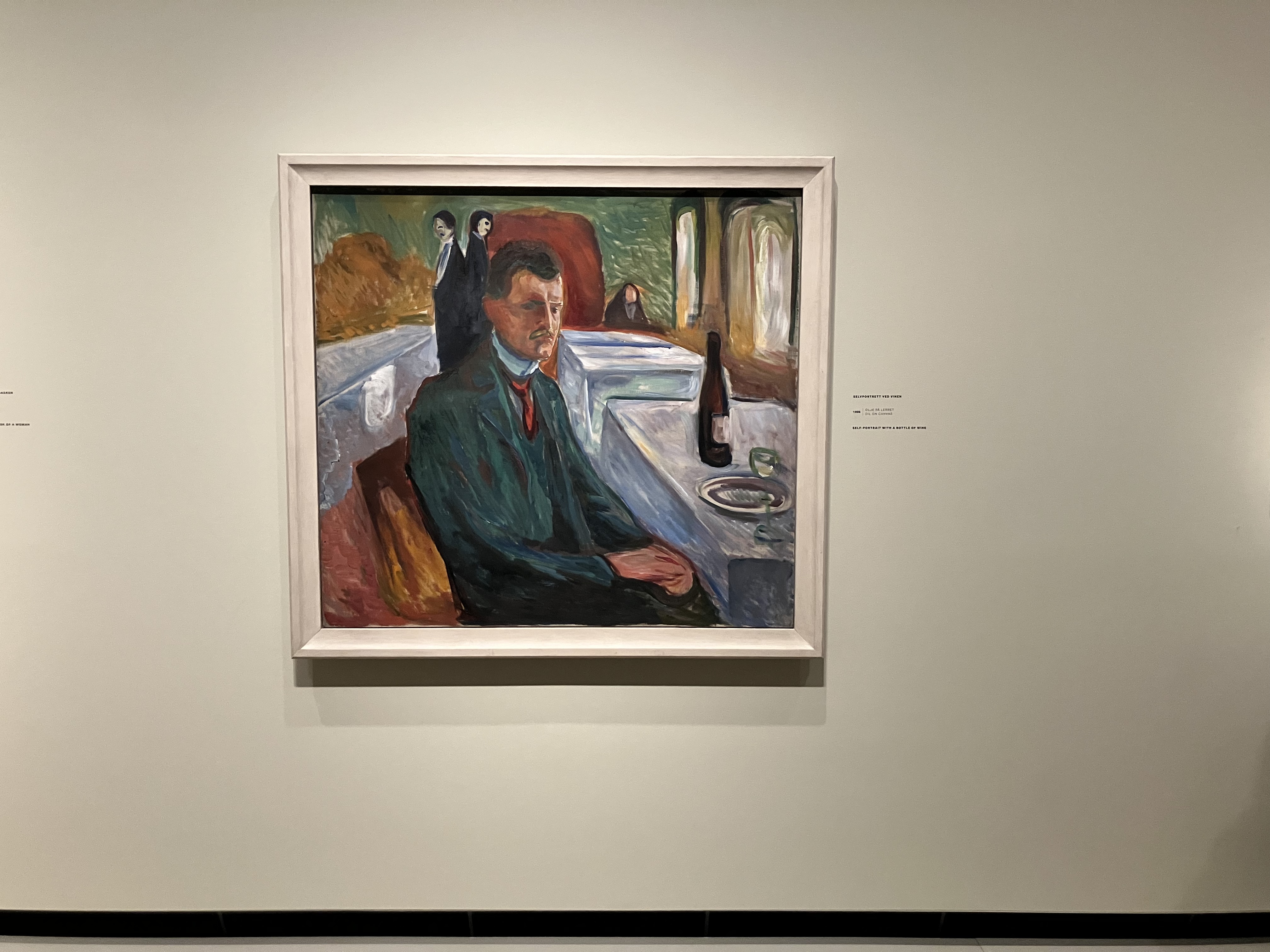
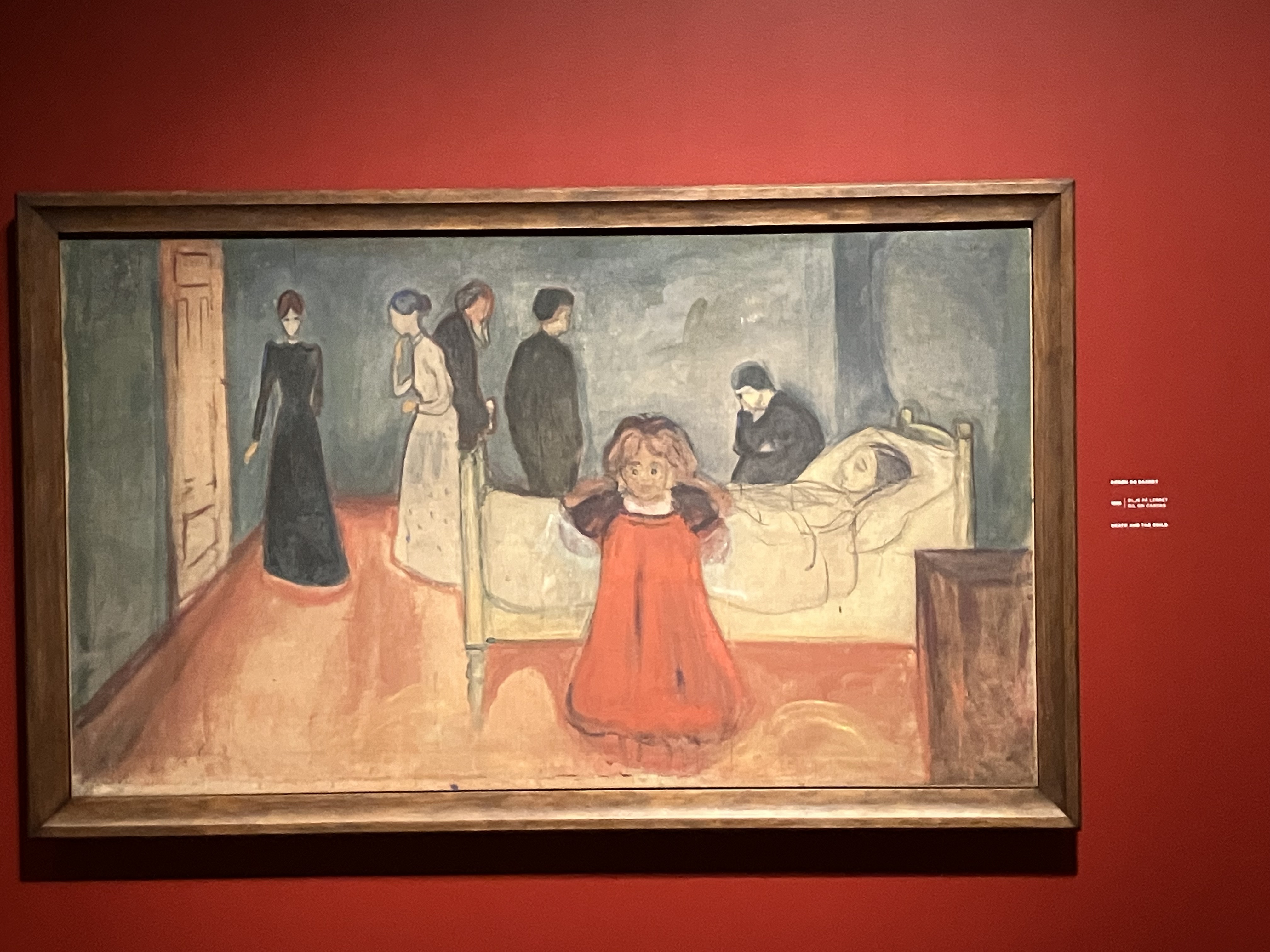
Edvard Munch, probably most famous as the artist for The Scream, has a museum devoted to him. While The Scream is not my personal favorite of his works depicted, I was pleasantly surprised at enjoying the gallery. I just needed some black coffee and to put some Joy Division on a Walkman, and I’d have the perfect goth rock aesthetic setting. These paintings are, yes, dark and dreary, but also an honest reflection of the day-to-day realities of life and death.
A DISCRETION: I should point out that several of these photographs of artwork containing nudity.
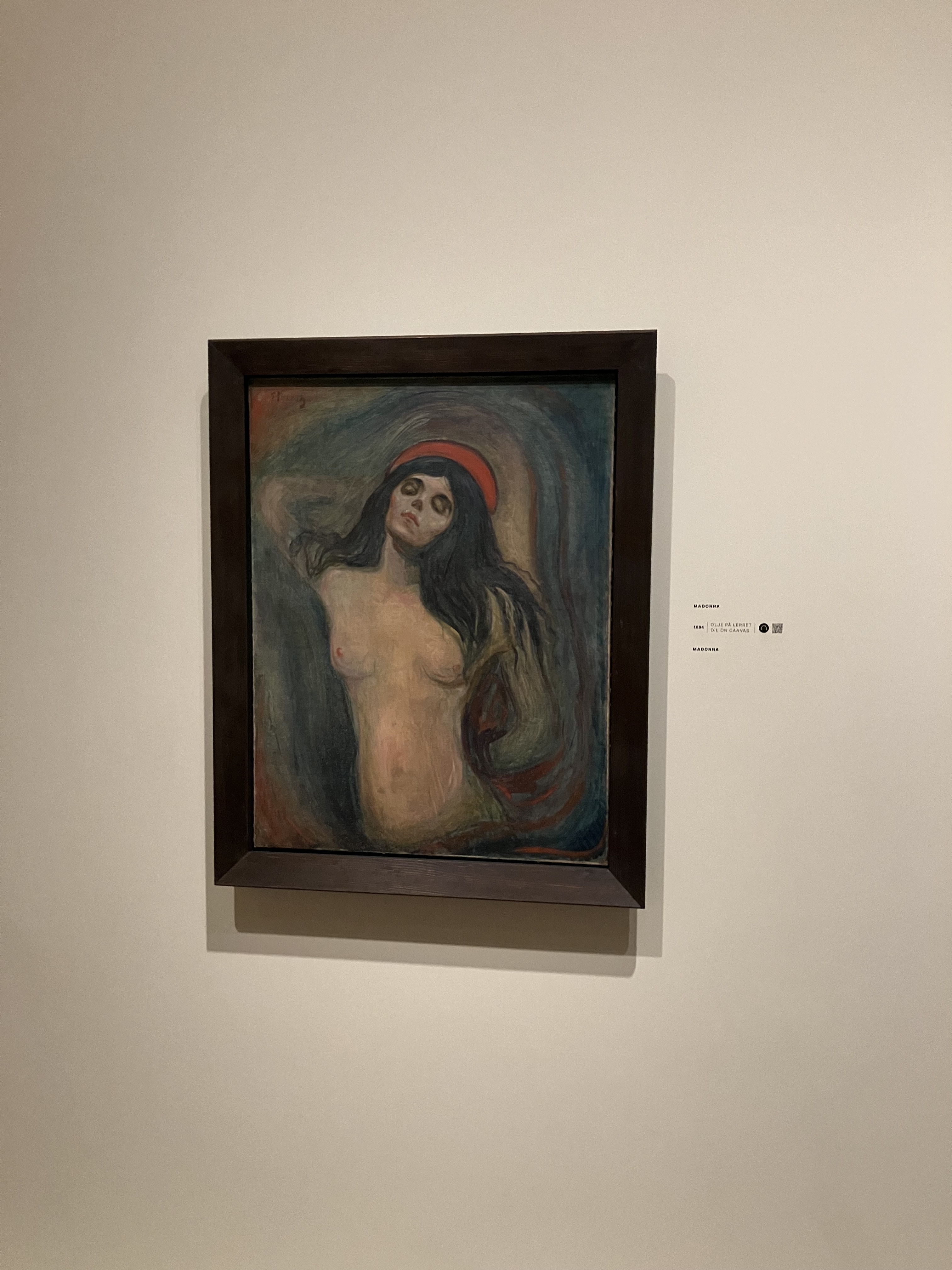
At a glance the simplistic lack of detail in these paintings may seem crude, but I personally find that aspect of Munch’s work emblematic of a stream of consciousness of feeling more than direct sensory; what the artist feels rather than what they see.
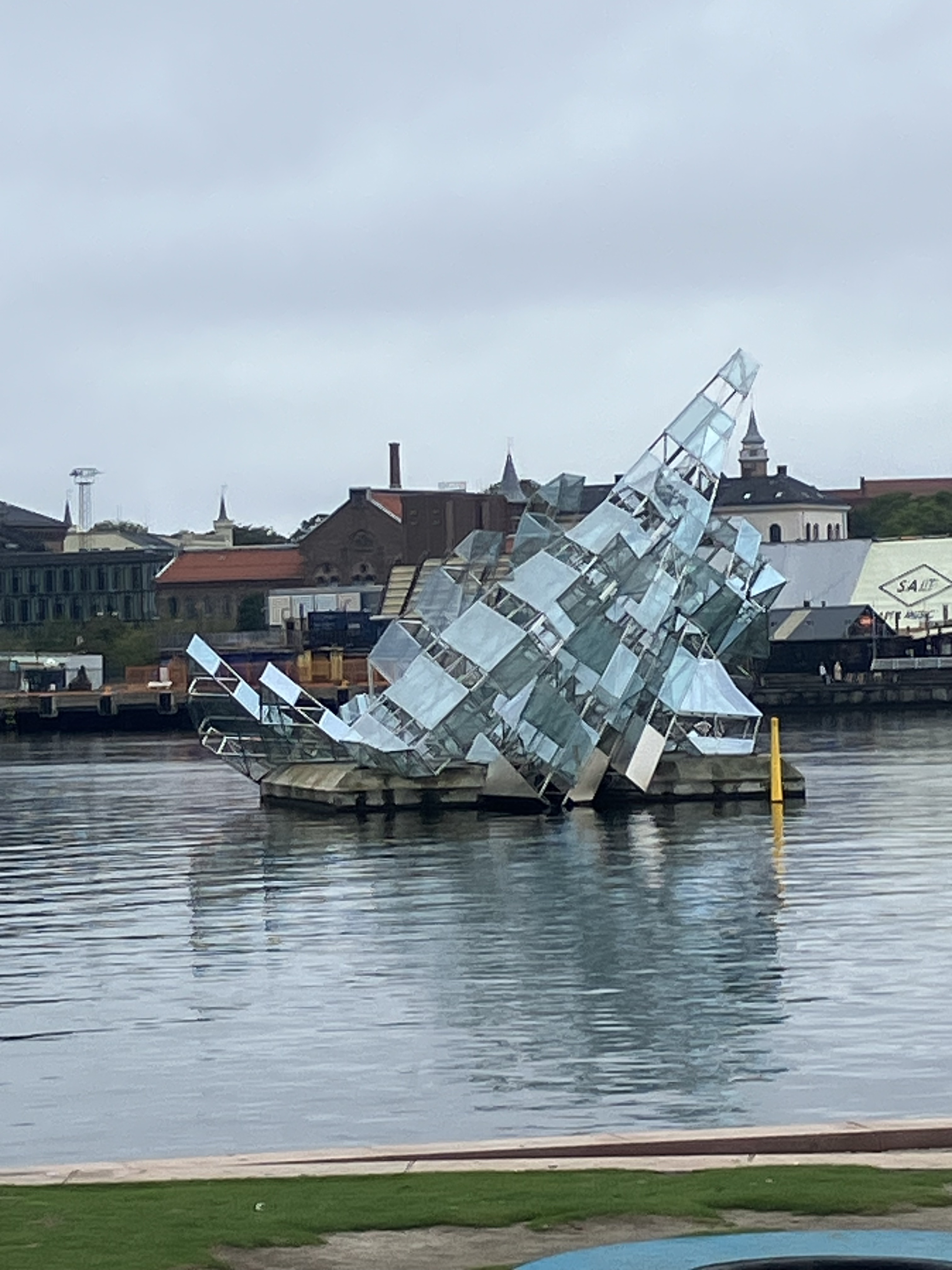
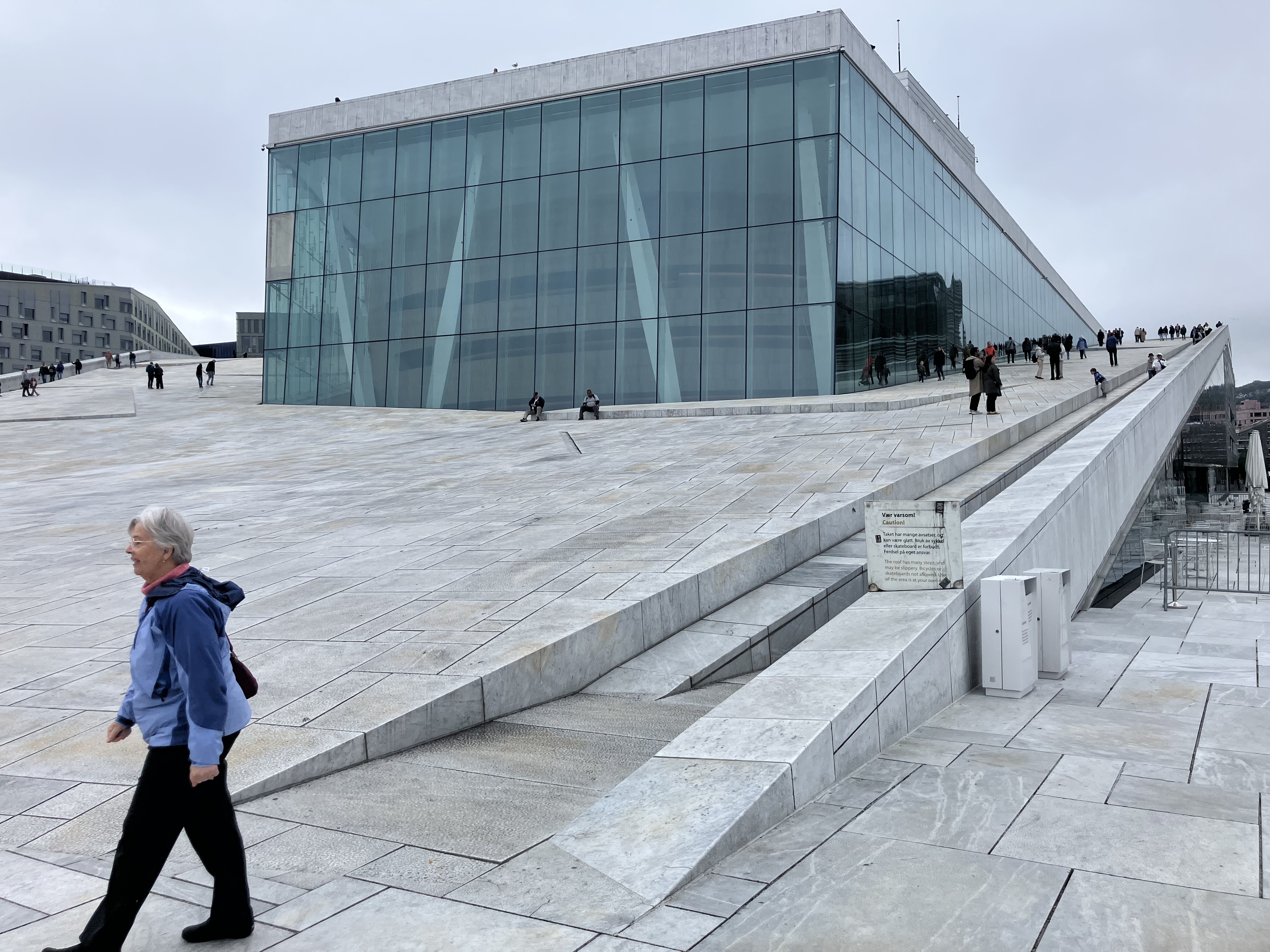
We had our pre-packed lunch outside the Munch museum, looking towards the Bay. A large, hungry seagull monitored us hoping we’d surrender or drop our sandwiches. There were plenty of interesting sights along the harbor, including the renowned Opera house Operahuset Oslo. My mother managed to locate a sole ticket for the Prokofiev’s Romeo and Juliet for the following Sunday afternoon. While my mother attended the ballet the next day, my father and I thankfully managed to locate something else that was of particularly interest to my father and happened to be one of the locations Bill and Sam went, the Holmenkollbakken, which I’ll detail in my next entry.
There was an interesting looking venue called Salt, which apparently serves as both a public events space and a sauna, but was under repair. But there are plenty of saunas near the opera house to choose from, which I may take advantage of on the less crowded weekdays as a reprieve from my race. I was too tired and sore after my race to peruse, but perhaps a trip to a sauna may be a good way to de-stress and meet some locals.
By the time we had secured the ballet ticket, we still had more hours to kill before the 10-k runners started; more than we originally thought. We couldn’t go out for lunch, because I needed to keep my digestive system undisturbed, and we didn’t want to arrange any additional museum tours in areas outside of town, as that would require walking too far, so I proposed we exclusively set our sights on the City Hall which was adjacent to the finish line.
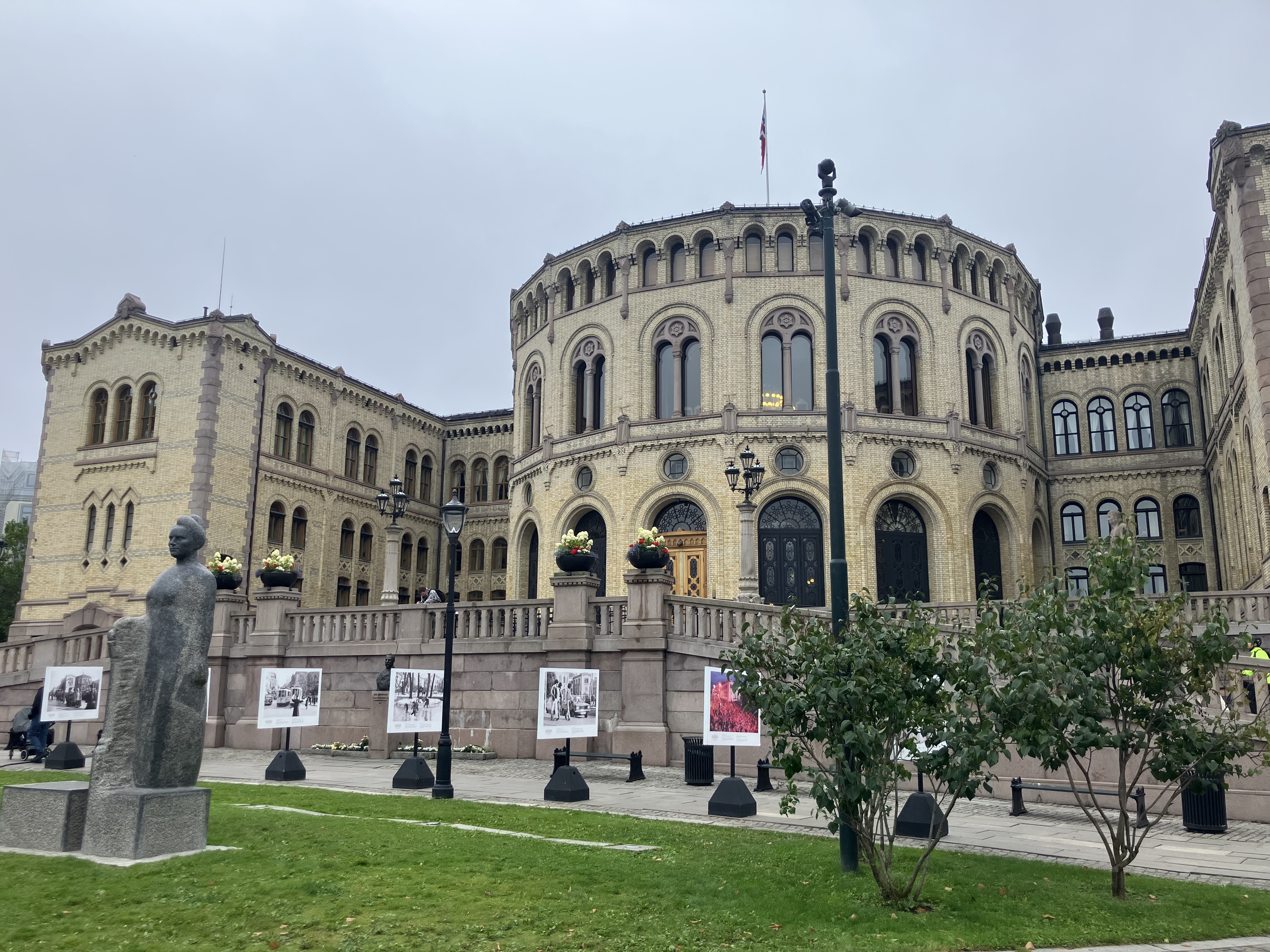
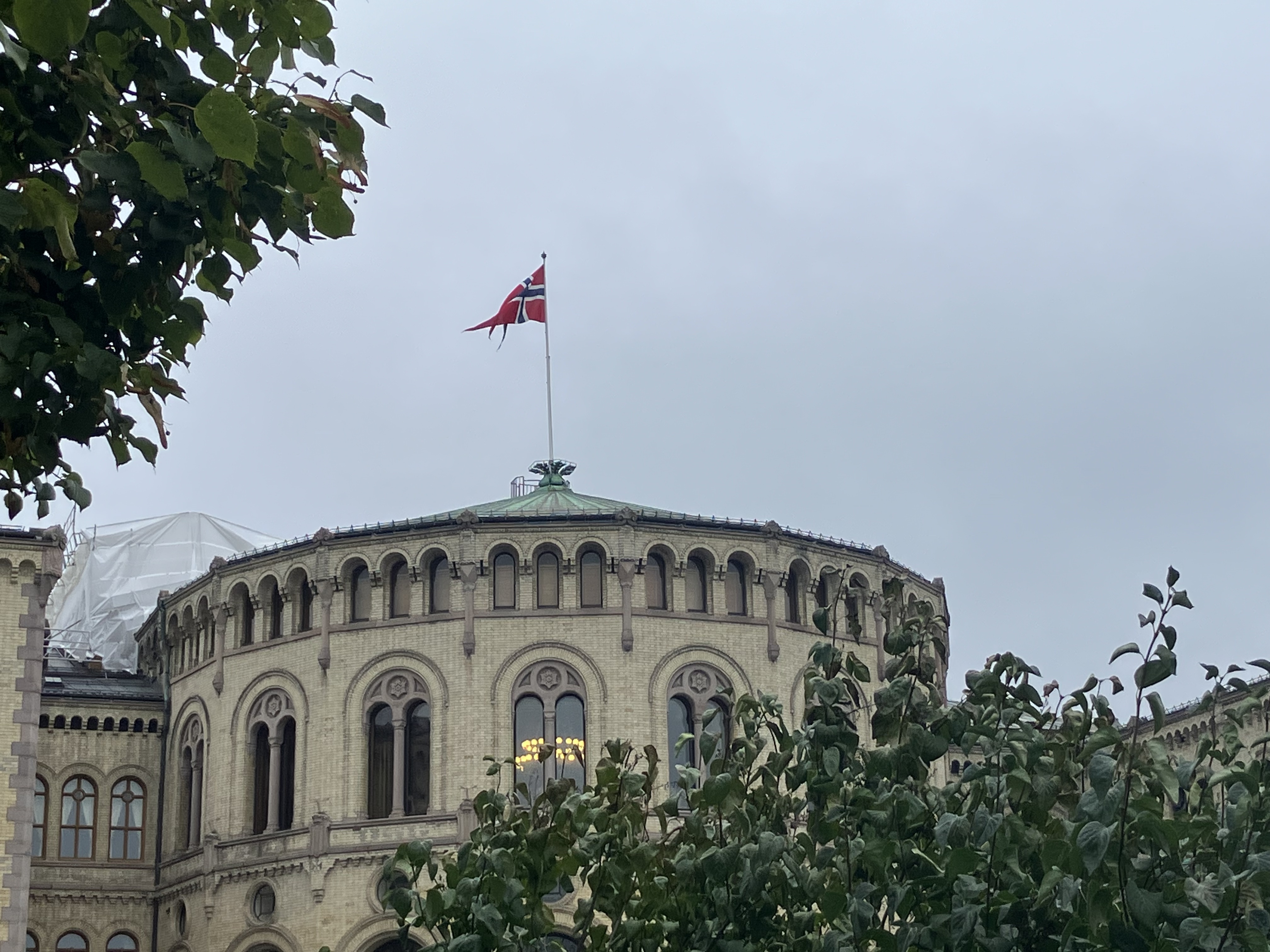
We wandered slowly up the direction towards the city hall which is also close to Norway’s parliamentary building (pictured above).
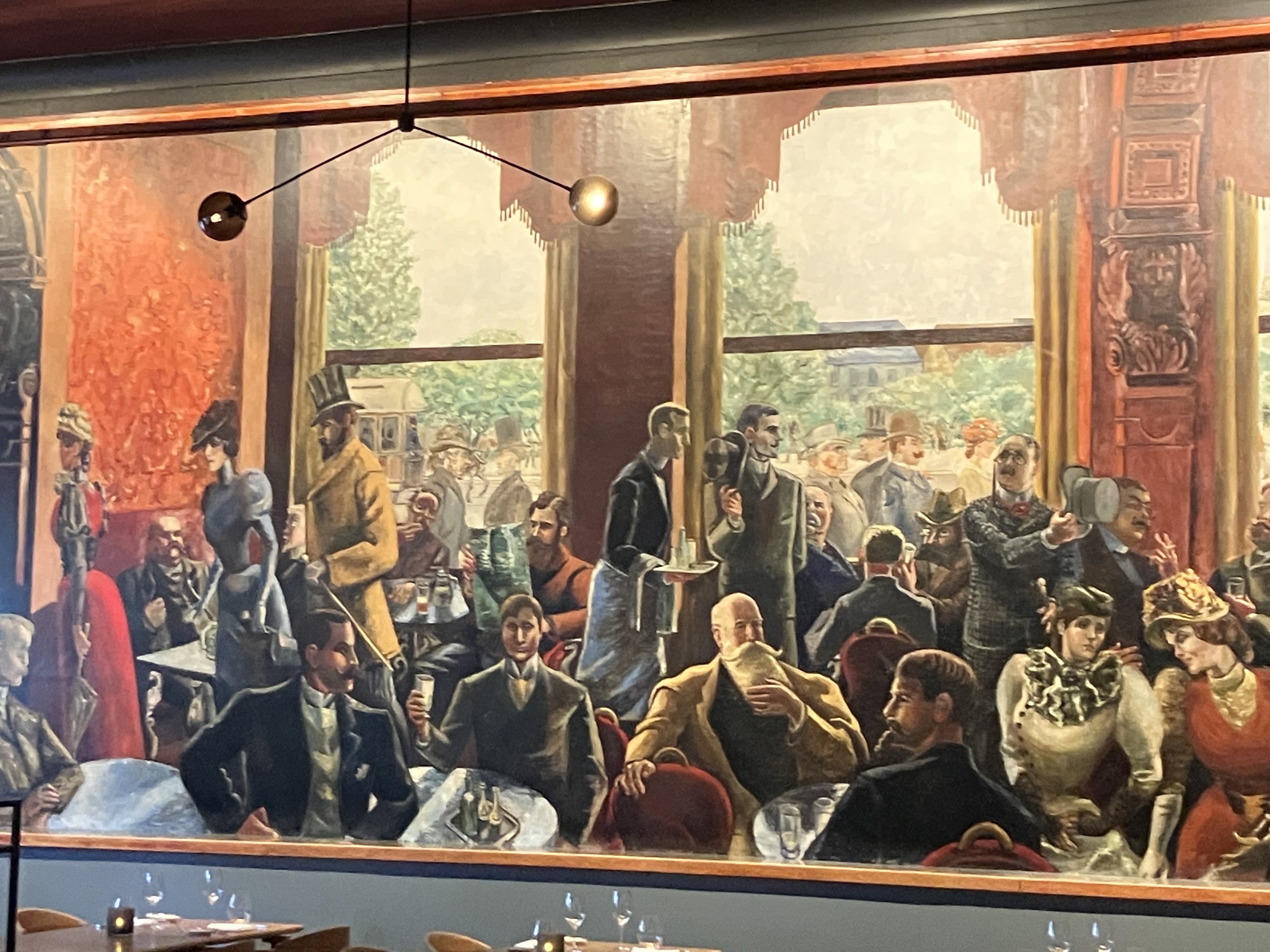
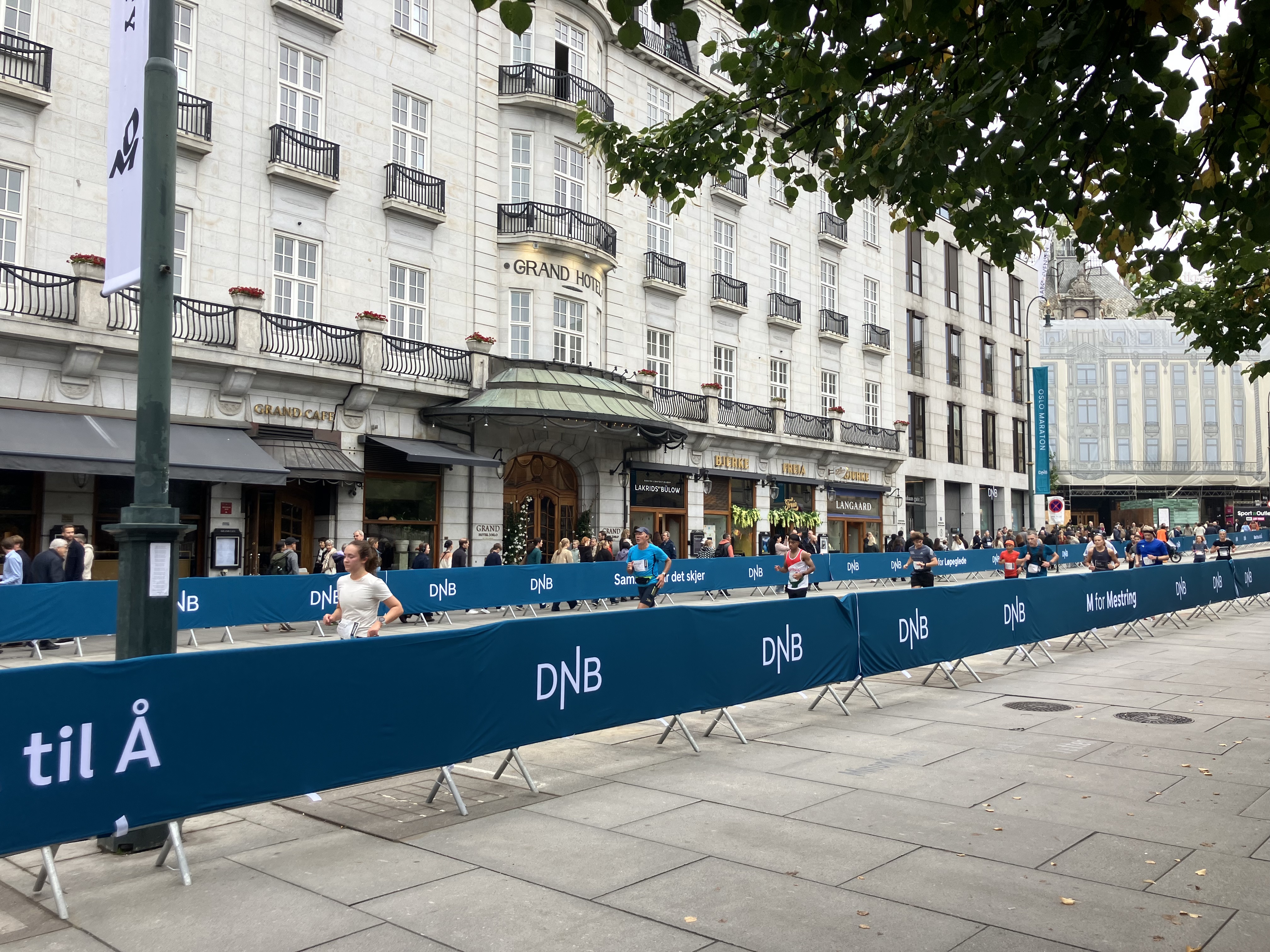
Also nearby is coincidentally one of the key places that my grandfather and Bill visited, the Grand Café as part of the historic Grand Hotel on Karl Johans Gt. Apparently, the duo stopped in this hotel’s cafe in 1936 and my grandfather ordered boiled milk to help with a upset stomach. They had been on their bike tour through many rural, sparsely-populated towns in Norway previously.
Pictured here is the artwork unchanged since that time, though I also heard there was a renewal project recently, so it probably didn’t look as it did in the 1930s.
I only ordered a sparkling water and a tiny piece of desert pictured below:
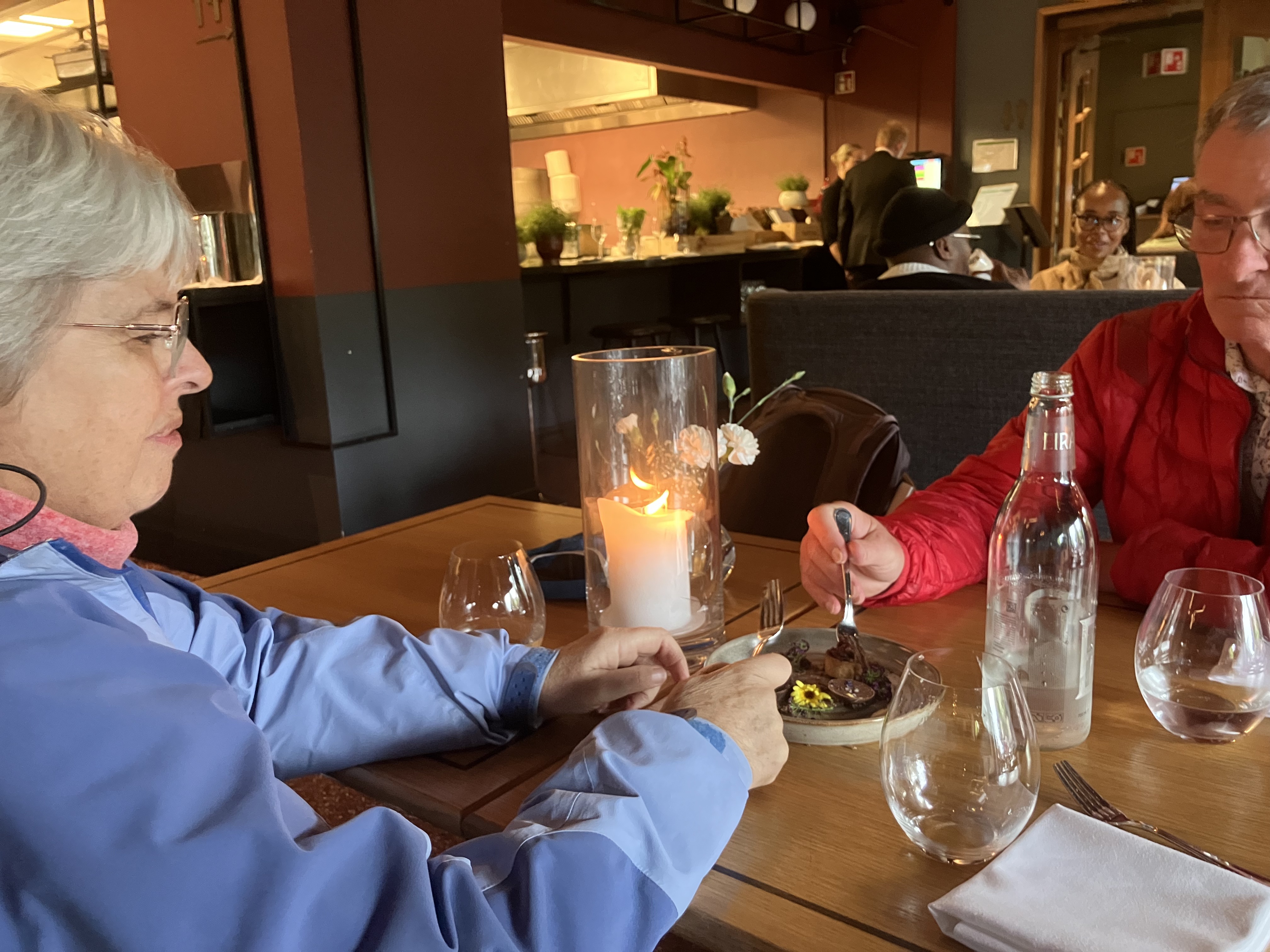
This historic street leads to several of Oslo’s key sites, including its national theater (where my parents are pictured), and does lead to the Royal Norwegian palace or Det Kongelige slott, which we didn’t find at the time, but from what I learned a day later from a Canadian tourist that it was closed to the public due to the mourning of the King, which several Norwegians tributed with flowers according to a Canadian tourist I chatted with the day after the race.
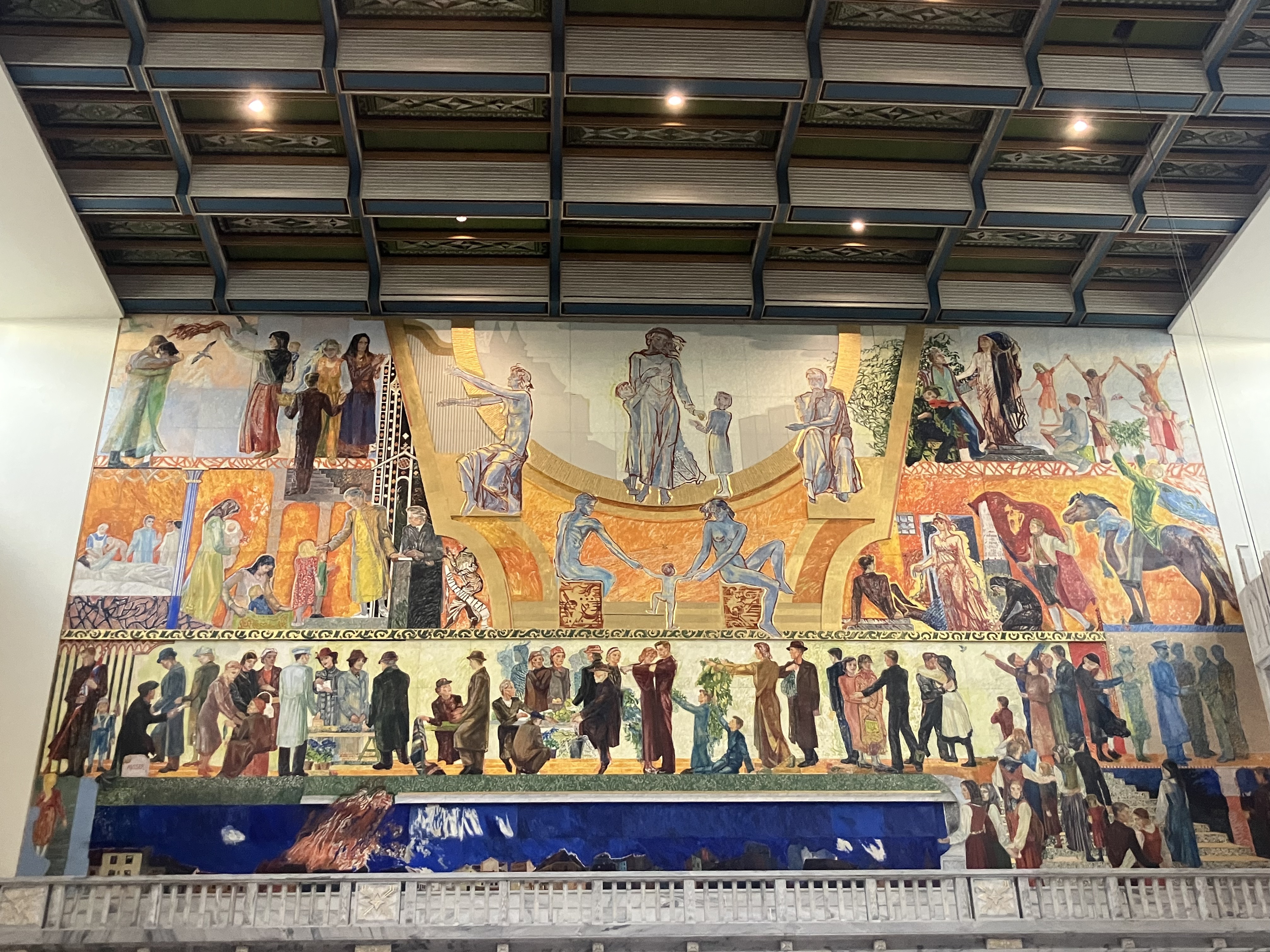
As with Stockholm’s City Hall, Oslo’s is a must to see. Rather than proclaim one as better than the other, I will simply point out that Oslo’s aesthetic leans more towards the artistic as opposed to the architectural. The best part I argue about this city hall is after you enter, unlike Stockholm’s Golden room.
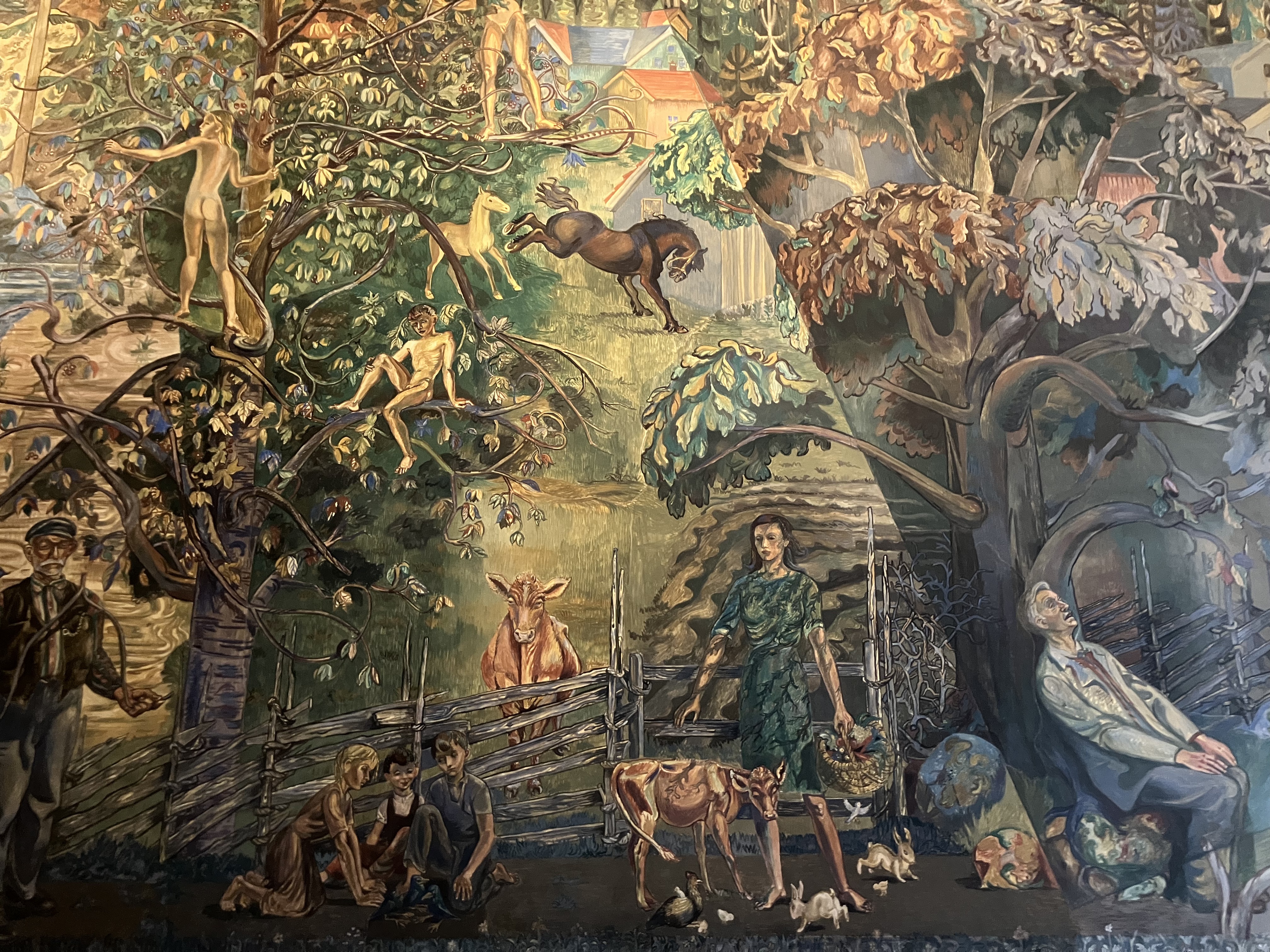
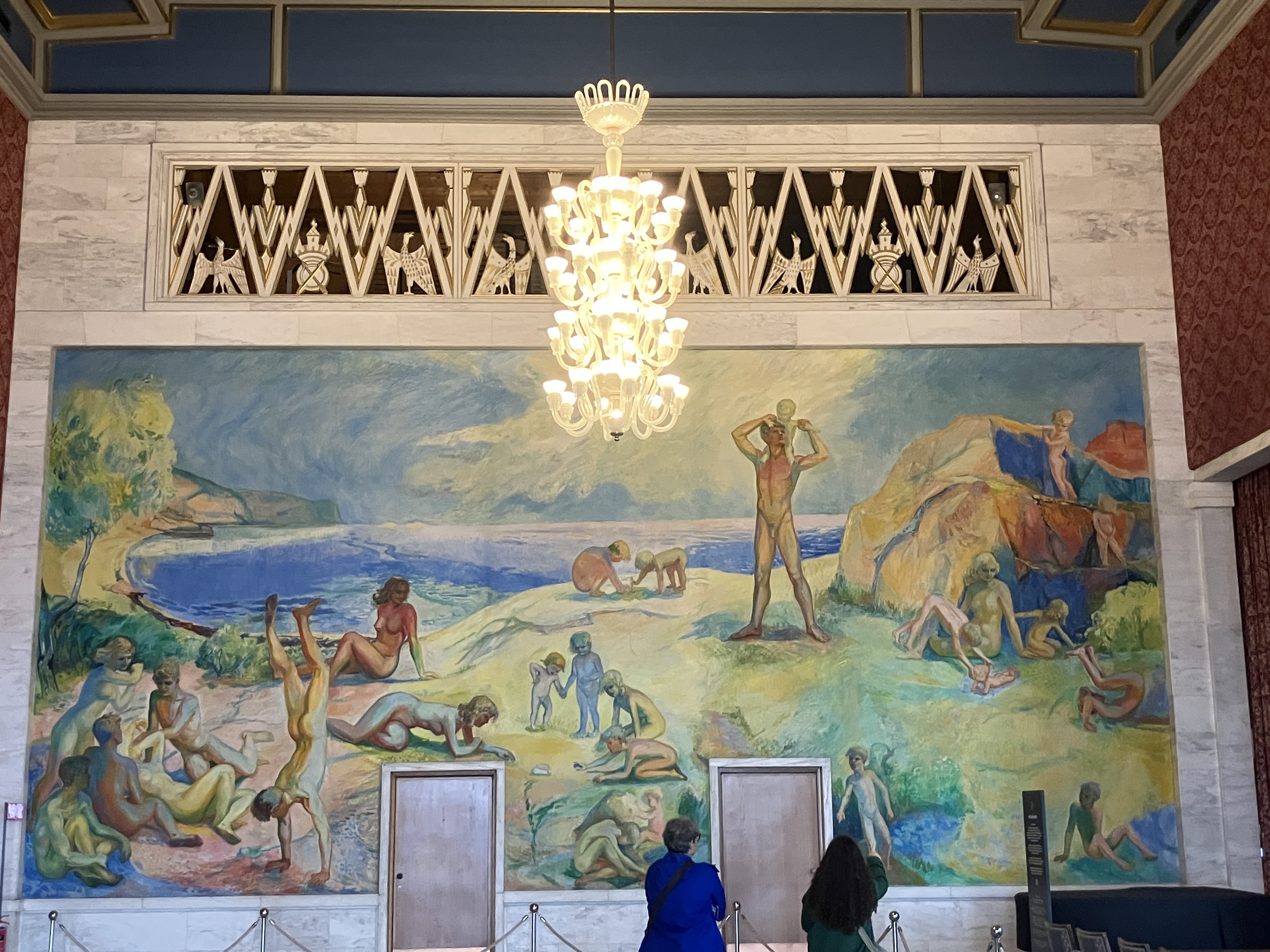
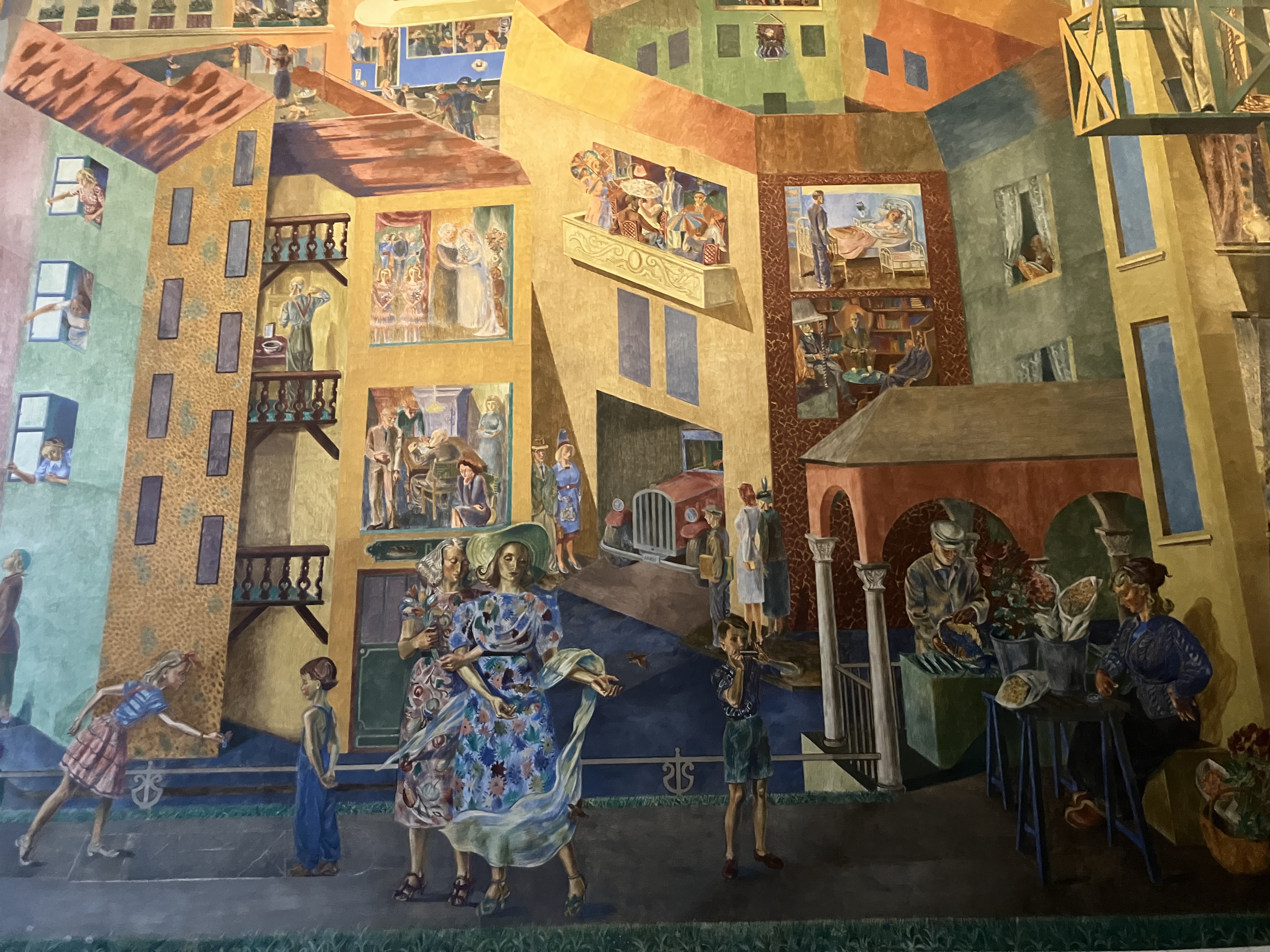
Also, unlike Stockholm, we weren’t offered a tour nor though we didn’t have to pay. Once inside I found myself in awe of the grandeur of these modern painting styles to signify the people of Norway. Despite having a monarch, there is a sense of individualistic values and democracy that resonates with this building’s aesthetics. To come to work every day as a city council member or any civil servant must feel near utopian.
The city hall’s back window also provided a good view of the race below which as you can see from the photo represents a packed event. We had already witnessed the marathoners and half-marathoners which were as frequent on the roads as rush hour traffic in any major city, with several roads closed off for the event, as was expected.
Every room of the city hall has wall paintings which I’ll have to do my own research of their creation, as the artistry seems familiar throughout as if there was one artist. There are occasionally artifacts like foreign gifts, Nobel prizes won by Norwegians on display, but only a minimal amount relative to these wall paintings.
When I had approximately 45 minutes to an hour remaining before my race started, I changed into my racewear in the City Hall lavatory. Each race group based on historical performance/speed was separated by groups by 10-minute-intervals, and I was assigned to group 4.
I’m happy to report that I cleared a personal record in my 10-kilometer running history with a time of 42:15. My parents unfortunately were unable to show me in action or at the finish line, but that’s not their fault. I originally told them that I expected to arrive in 50 minutes, but that was an overestimation, and therefore they moved from the finish line to catch me somewhere else along the route that I had already surpassed after they arrived. I partly blame that on my conversion from English to metric, since 10 kilometers is 6.3 miles, and I was comparing this race to a 7.2-mile race in Spokane, Bloomsday, where I was trying to surpass that record.
While I do not speak Norwegian, the universality of running helped me blend in my routine pre-race, stretching and following my fellow runners running warm-up loops around the city blocks designated for those racing near the city hall campus. I tripped and fell on the concrete after a woman opened one of the porta potty doors into my shoe causing me to bruise a little, but thankfully I don’t believe in omens. After another runner helped me up a New Yorker asked if I was from Washington State after noticing my UW hat, which I affirmed. There were some Americans and other nationalities at this race, though from the roster, it is predominately Norwegian locals that occupied this race. For such a small country, I admit there are plenty of athletes per capita, and while skiing may be the first sport that comes to mind, running is no exception.
Unlike Bloomsday, the weather here is more like Western Washington with more humidity, but flatter and closer to sea level, which may have helped me run faster. I made the mistake of not venturing to the front of my group, which was separated into nine areas, so weaving through each of the runners proved an initial challenge, and since I haven’t memorized the Norwegian word for excuse me, Unnskyld meg, for the first quarter of a mile I only managed a 7:50 mile pace (12 kilometers).
The running packs eventually started to dissipate, and I eventually made a game of surpassing as many of these packs of people as I could. There was one, I presume, Norwegian young man, probably in his mid-twenties who gathered that I was near his pace and tapped my shoulder at some point to indicate that while coned off, it was acceptable to pass the slower runners using sidewalks of these streets. I wish I could have met this man at the finish to shake his hand for the reminder and sharing of this logic.
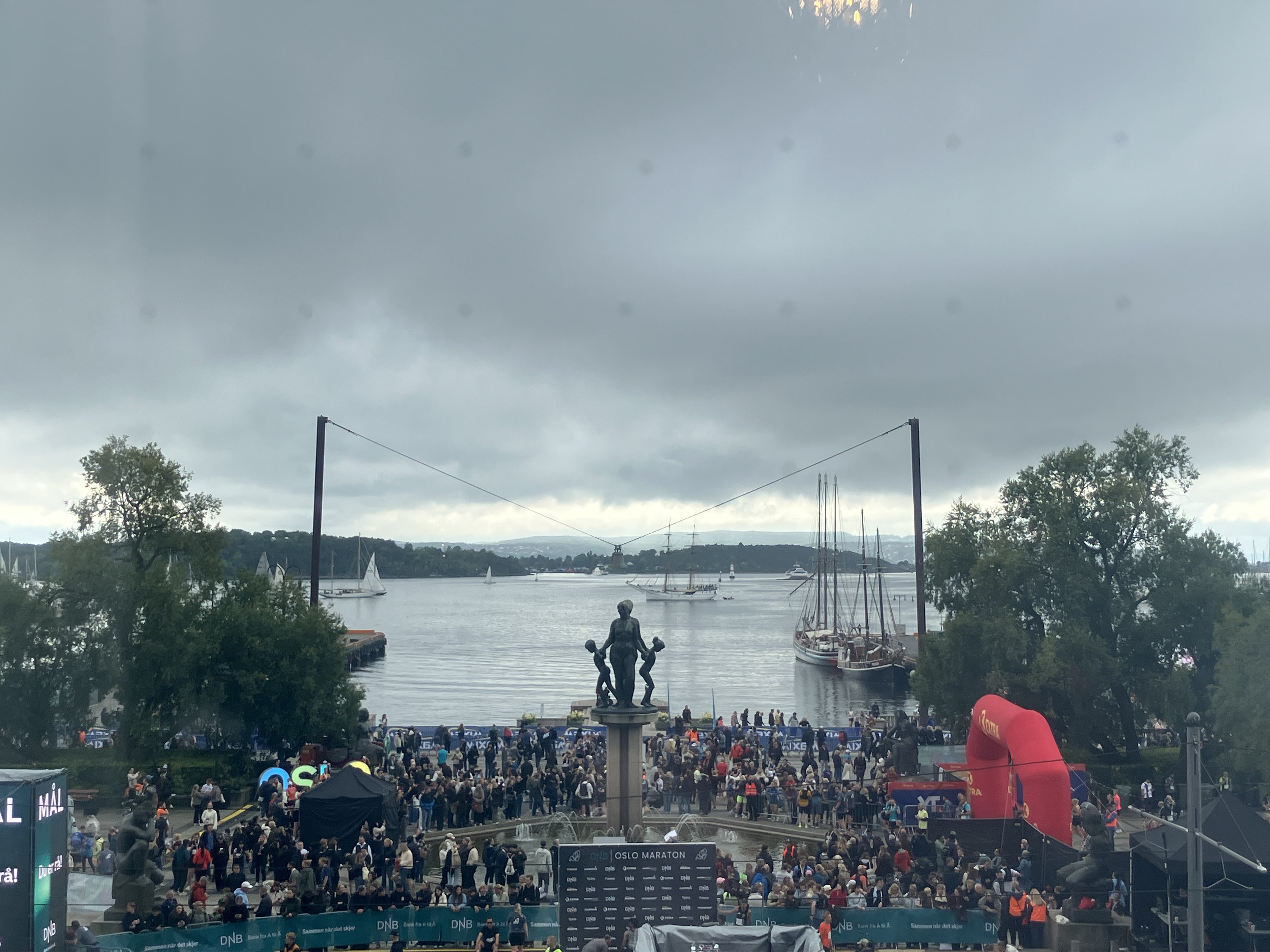
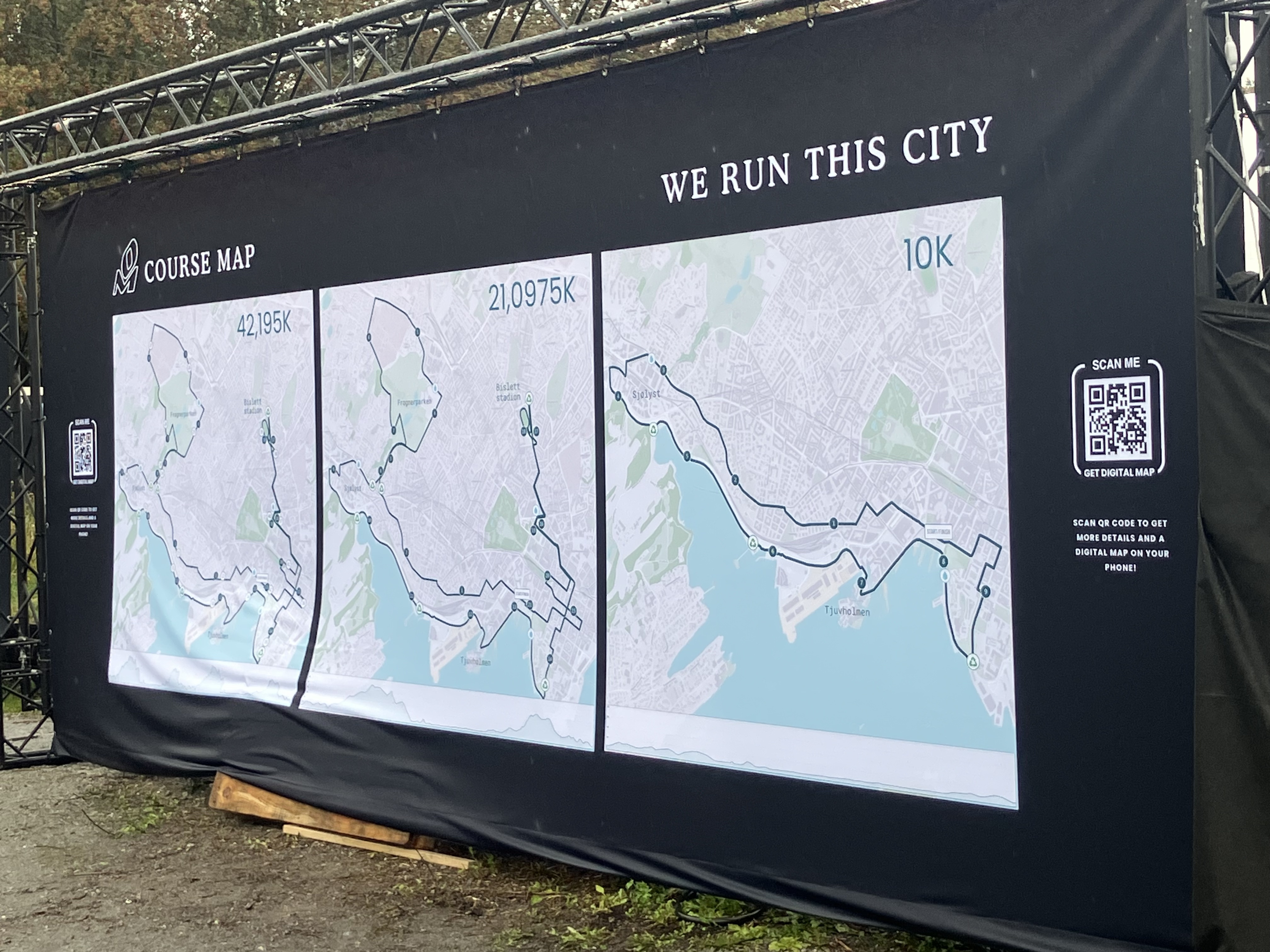
There are very few differences in substance and function of this Norwegian marathon compared with an American one. Yes, the metrics and language are different, but the distances, the crowds of people, the sponsors for shoes, energy bars, and whatnot and the ambience of megaphones, cheers, and local businesses popping were ever-present. Oslo itself, especially compared with Stockholm, is a very modern city, even more in certain ways than most US cities I’ve visited. Most of the cityscape architecture, which I only had a split second to witness as I ran through the Norwegian rain towards the finish line adjacent to City Hall is robust, practical, and modern and is a true testament to urban planning. I would compare it with Vancouver, Washington. The one true eye-catcher on my run however was on the harbor just as I turned towards the downtown section that takes one within blocks near the city center and the Parliament building was an 18th century ship with sails and riggings, I presume for historical preservation. If I have time, I will try to locate this vessel to identify whether it’s a museum, a restaurant or whatnot.
The finish line is probably my favorite of any race. To be fair, I haven’t run Boston, New York, or Chicago to compare, but the artwork outside the City Hall is incredible, but the outside artwork and coastal location are difficult to beat.
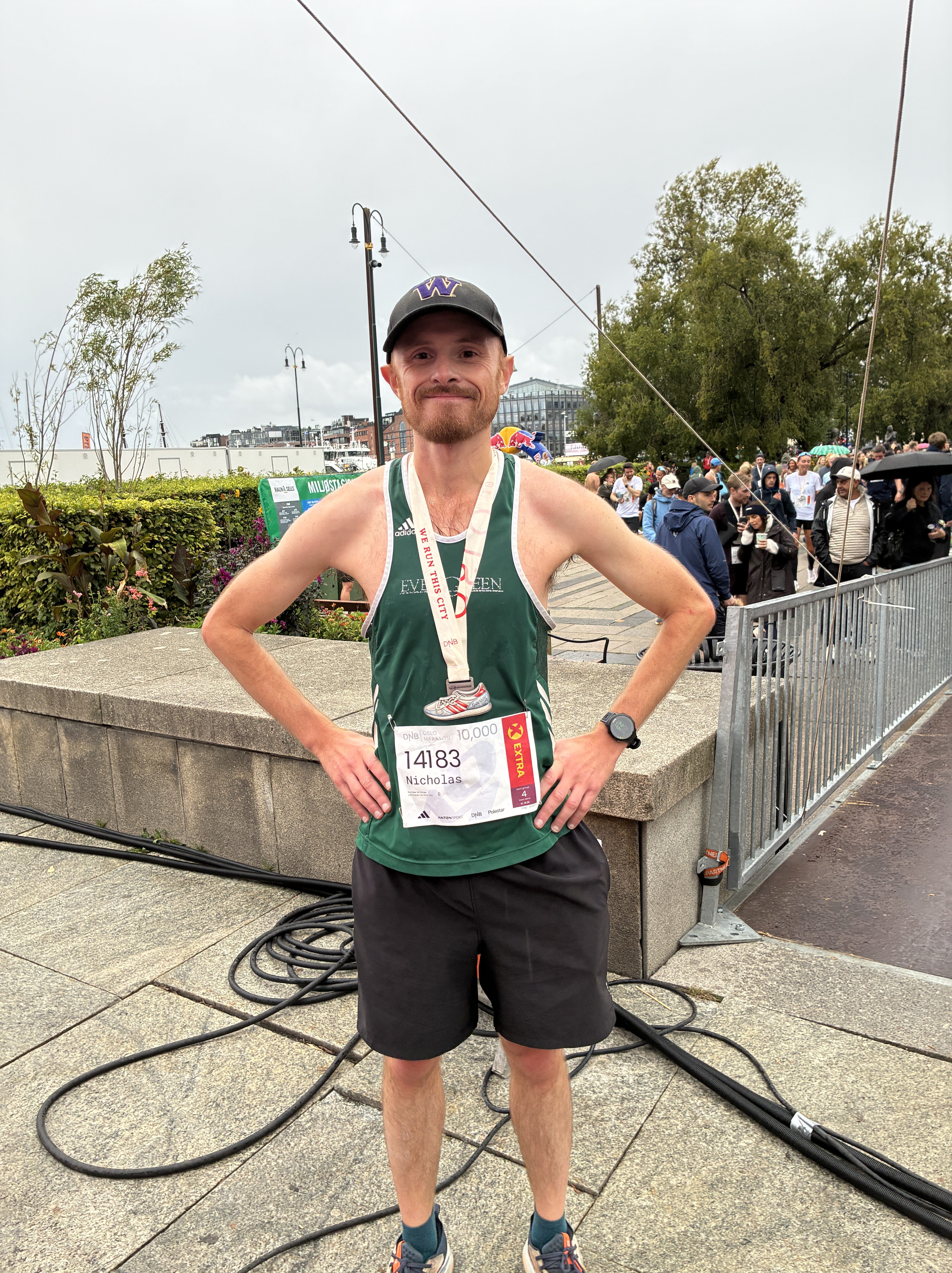
After a long hard day, my parents and I went straight home, as we were all tired and wanted nothing more than a good night’s sleep and a simple heart meal of salmon, rice, and roasted vegetables in our apartment kitchen.
We have two more days in Oslo, and then it’s on to Bergen and then Stavanger.
NOTE: I published this post a day after our second day of stay in Oslo, Sunday, September 13, 2026, but that will have to wait.
 In the footsteps of Bill and Sam